VELOCITY 2
VELOCITY-II
Relative velocity
Relative velocity is a measurement of velocity between two objects as determined in a single coordinate system. Relative velocity is fundamental in both classical and modern physics, since many systems in physics deal with the relative motion of two or more particles. In Newtonian mechanics, the relative velocity is independent of the chosen inertial reference frame. This is not the case anymore with special relativity in which velocities depend on the choice of reference frame.
If an object A is moving with velocity vector v and an object B with velocity vector w, then the velocity of object A relative to object B is defined as the difference of the two velocity vectors:
- , if the two objects are moving in opposite directions, or:
- , if the two objects are moving in the same direction.
Polar coordinates
In polar coordinates, a two-dimensional velocity is described by


Usually, the inertial frame chosen is that in which the latter of the two mentioned objects is in rest.

Scalar velocities
In the one-dimensional case,[3] the velocities are scalars and the equation is either:



Similarly, the relative velocity of object B moving with velocity w, relative to object A moving with velocity v is:
- a radial velocity, defined as the component of velocity away from or toward the origin (also known as velocity made good), and an angular velocity, which is the rate of rotation about the origin (with positive quantities representing counter-clockwise rotation and negative quantities representing clockwise rotation, in a right-handed coordinate system).
The radial and angular velocities can be derived from the Cartesian velocity and displacement vectors by decomposing the velocity vector into radial and transverse components. The transverse velocity is the component of velocity along a circle centered at the origin.
where
- is the transverse velocity
- is the radial velocity.
The magnitude of the radial velocity is the dot product of the velocity vector and the unit vector in the direction of the displacement.
where
- is displacement.
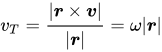
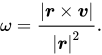
The magnitude of the transverse velocity is that of the cross product of the unit vector in the direction of the displacement and the velocity vector. It is also the product of the angular speed and the magnitude of the displacement.
such that
Angular momentum in scalar form is the mass times the distance to the origin times the transverse velocity, or equivalently, the mass times the distance squared times the angular speed. The sign convention for angular momentum is the same as that for angular velocity.
where
- is mass
The expression is known as moment of inertia. If forces are in the radial direction only with an inverse square dependence, as in the case of a gravitational orbit, angular momentum is constant, and transverse speed is inversely proportional to the distance, angular speed is inversely proportional to the distance squared, and the rate at which area is swept out is constant. These relations are known as Kepler's laws of planetary motion.
- Sources:
- Khan Academy
Wikipedia






Comments
Post a Comment