VELOCITY 1
VELOCITY-I

A vector measurement of the rate and direction of motion is defined as velocity. Simply put, velocity refers to how fast something moves in one direction. Velocity may be used to calculate the speed of a car heading north on a major highway and the speed of a rocket launching into space.
As you may expect, the velocity vector's scalar (absolute value) magnitude is the speed of light.
What exactly does velocity imply?
Your understanding of velocity is most likely the same as the scientific definition. You already know that a significant displacement in a short period of time equals a high velocity, and that velocity is measured in distance divided by time units like miles per hour or kilometres per hour.
The average velocity is calculated by dividing the change in location by the journey time.
vavg=ΔtΔx=tf−t0xf−x0
In this formula,
Acceleration, Velocity, and Peed
Though they reflect separate metrics, speed, velocity, and acceleration are all related. Make sure these values aren't confused with one another.
Speed is a scalar quantity that reflects the rate of motion distance per time, according to its technical definition. It has two units: length and time. To put it another way, speed is the distance travelled in a certain length of time. The distance travelled per unit of time is a common way to describe speed. It is the rate at which an object moves.
Velocity is a three-dimensional vector quantity that represents movement, time, and direction. Unlike speed, velocity is a vector quantity that measures displacement.

The difference between an object's final and initial placements is indicated. Distance, a scalar quantity that measures the whole length of an object's route, is measured by speed.
Acceleration is a vector quantity that represents the rate at which velocity changes. It has length and time over time dimensions. Acceleration is sometimes referred to as "speeding up," but it actually refers to velocity changes. In a car, acceleration can be felt on a daily basis. When you press the accelerator, the car accelerates, increasing its speed.
Why Is Speed Important?<make heading>
Velocity is a unit of measurement for motion that starts in one location and moves to another. One of the most common reasons to measure velocity is to determine how quickly you (or anything in motion) will arrive at a destination from a particular point.
Velocity enables students to design travel timetables, which is a typical form of physics issue. For example, if a train departs Penn Station in New York at 2 p.m. and you know the train's northward velocity, you can estimate when it will arrive in Portland's South Station.

Quantities that are dependent on velocity
The kinetic energy of a moving object is dependent on its velocity and is given by the equation

ignoring special relativity, where Ek is the kinetic energy and m is the mass. Kinetic energy is a scalar quantity as it depends on the square of the velocity, however a related quantity,momentum, is a vector and defined by

In pecial relativity, the dimensionless Lorentz Factor appears frequently, and is given by
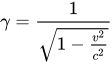
where γ is the Lorentz factor and c is the speed of light.
Escape velocity minimum speed a ballistic object needs to escape from a massive body such as Earth. It represents the kinetic energy that, when added to the object's gravitational potential energy, (which is always negative) is equal to zero. The general formula for the escape velocity of an object at a distance r from the center of a planet with mass M is
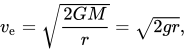
where G is the Gravitational constant and g is the Gravitational acceleration . The escape velocity from Earth's surface is about 11 200 m/s, and is irrespective of the direction of the object. This makes "escape velocity" somewhat of a misnomer, as the more correct term would be "escape speed": any object attaining a velocity of that magnitude, irrespective of atmosphere, will leave the vicinity of the base body as long as it doesn't intersect with something in its path.

Relative velocity is a measurement of velocity between two objects as determined in a single coordinate system. Relative velocity is fundamental in both classical and modern physics, since many systems in physics deal with the relative motion of two or more particles. In Newtonian mechanics, the relative velocity is independent of the chosen inertial reference frame. This is not the case anymore with special relativity in which velocities depend on the choice of reference frame.
If an object A is moving with velocity vector v and an object B with velocity vector w, then the velocity of object A relative to object B is defined as the difference of the two velocity vectors:

Similarly, the relative velocity of object B moving with velocity w, relative to object A moving with velocity v is:

Usually, the inertial frame chosen is that in which the latter of the two mentioned objects is in rest.
Scalar velocities
In the one-dimensional case,[3] the velocities are scalars and the equation is either:
- , if the two objects are moving in opposite directions, or:
- , if the two objects are moving in the same direction.




Comments
Post a Comment